Why Your OnePlus Says VOOC When It Isn't: USB-PD, PPS, and the SuperVOOC Architecture
Why Your OnePlus Reports VOOC When It Isn't
A OnePlus phone connected to a 100W third-party GaN charger displays a "VOOC" fast-charge indicator in OxygenOS. The indicator is misleading. The phone is negotiating USB Power Delivery with PPS and drawing approximately a quarter of what its battery hardware will accept. OxygenOS labels any negotiated rate above an internal threshold with the family name, regardless of the protocol actually in use.
This post covers what is on the CC pin during that negotiation, why third-party chargers cap where they do, and what would have to change for the same phone to charge at its rated peak. The relevant pieces are dual-cell battery topology, charge pumps versus buck converters, and a cable-side ID resistor that gates OPPO's high-current path.
USB Power Delivery

USB-PD is the open standard maintained by the USB-IF for negotiating power over USB-C. The model is straightforward: the source advertises a list of Power Data Objects (PDOs) — fixed voltage/current pairs such as 5V/3A, 9V/3A, 15V/3A, 20V/5A — and the sink selects one. Voltage steps are coarse and discrete. Conversion happens device-side: the phone receives 9V at the port and its internal buck IC steps that down to ~4.4V for the cell. Conversion losses dissipate as heat inside the phone.
The spec has gone through several revisions. Each adds capability without removing the older fixed-PDO model.
| Spec | Year | Max power | Voltages | Key addition |
|---|---|---|---|---|
| USB-PD 1.0 | 2012 | 100W | 5/12/20V profiles | First spec; ran over USB-A/B VBUS. Largely skipped. |
| USB-PD 2.0 | 2014 | 100W | 5V, 9V, 15V, 20V (fixed PDOs) | Rebuilt around USB-C. The "classic" PD everyone knows. |
| USB-PD 3.0 | 2015–2017 | 100W | Same fixed PDOs | Fast Role Swap, extended messages, battery status, firmware update over PD. |
| USB-PD 3.0 + PPS | 2017 | 100W | 3.3–21V in 20mV steps, 50mA current steps | Programmable Power Supply — chargers track battery voltage. |
| USB-PD 3.1 SPR | 2021 | 100W | Same as 3.0 (≤20V) | "Standard Power Range." Cleanups, better extended messages. |
| USB-PD 3.1 EPR | 2021 | 240W | Adds 28V, 36V, 48V fixed PDOs | "Extended Power Range." Requires EPR-rated e-marked cable (5A @ 50V). |
| USB-PD 3.1 EPR + AVS | 2021 | 240W | 15–48V adjustable (100mV steps) | Adjustable Voltage Supply — PPS's bigger sibling for the EPR range. |
| USB-PD 3.2 | 2023 | 240W | Same envelope as 3.1 | Tightens AVS, finer current granularity, multi-port budget signaling. |
Reading a charger's spec label:
- "PD 65W" with no PPS: fixed 20V/3.25A. Adequate for laptops, suboptimal for modern phones because it forces a high-ratio buck.
- "PD 65W PPS": at least one PPS PDO, typically
3.3–11V @ 5Aor3.3–21V @ 3A. This is what a 2024+ phone targets. - "PD 3.1 / EPR 140W+": includes 28V or 36V fixed PDOs. Apple's 140W MacBook Pro charger and the higher-tier Anker / UGREEN units fall here. Delivery above 100W requires an EPR-rated cable.
- "AVS" on the label: PD 3.1 EPR with adjustable voltage. Currently limited to enthusiast GaN units.
PPS specifically
PPS is the section of PD 3.0 most relevant to phones. The sink requests voltage in 20mV increments and current in 50mA increments and adjusts continuously. Rather than "9V/3A, device copes," the phone requests "8.74V at 4.20A," then a few hundred ms later "8.78V at 4.18A," and the source tracks.
This matters for thermal behavior. The phone's charge IC has the least conversion work when the input voltage is close to twice the cell voltage. A buck or charge pump operates most efficiently at small, predictable conversion ratios. With fixed PD the input is always 9V or 15V regardless of state-of-charge; with PPS the input slides as the cell fills, holding the conversion stage near peak efficiency throughout the curve.
PPS adoption on Android is broad: Samsung Super Fast Charging 2.0 (45W), Pixel fast charging, and every modern OnePlus when paired with a non-OPPO charger all use PPS. iPhones do not request PPS; they negotiate fixed 9V or 15V PDOs and let the internal IC handle the rest.
The OPPO family: Dash, Warp, VOOC, SuperVOOC
OPPO's proprietary fast-charge family began with VOOC in 2014. OnePlus rebranded the protocol twice — first as Dash, then as Warp — before consolidating to VOOC and SuperVOOC after the 2021 OnePlus/OPPO merger. The underlying technology in each generation is the same lineage; the renames are organizational.
| Name | Era | Typical wire spec | Architectural trick |
|---|---|---|---|
| VOOC 1.0 | 2014, OPPO | 5V / 4A (20W) | Low voltage, high current. Charger does the heavy regulation. |
| Dash Charge | 2016–2018, OnePlus | 5V / 4A (20W) | OnePlus rebrand of VOOC. Same tech. |
| Warp Charge 30 | 2018, OnePlus | 5V / 6A (30W) | More current at the same voltage. |
| Warp Charge 65 | 2020, OnePlus | 10V / 6.5A (65W) | OnePlus rebrand of SuperVOOC 2.0. |
| VOOC 4.0 | 2019, OPPO | 5V / 6A (30W) | Same tier as Warp 30. |
| SuperVOOC 1.0 | 2018, OPPO | 10V / 5A (50W) | Dual-cell series battery. Charge pump in the phone. |
| SuperVOOC 2.0 | 2020 | 10V / 6.5A (65W) | — |
| SuperVOOC 80W | 2021 | 10V / 8A | — |
| SuperVOOC 100W | 2022 | 10V / 10A | — |
| SuperVOOC 150W | 2022 | 20V / 7.5A | Higher voltage, deeper charge-pump ratio. |
| SuperVOOC 240W | 2022 | 24V / 10A | Reference design. Production phones top out near 100W. |
Everything from SuperVOOC 1.0 onward is architecturally distinct from PD and from the earlier Dash/Warp/VOOC line. The next section covers why.
What distinguishes SuperVOOC
Four mechanisms, which compound.
1. Dual-cell series battery
A SuperVOOC phone uses two battery cells wired in series. A OnePlus 12, for example, ships two ~2700 mAh cells whose terminals are connected (+)–[cell A]–(–)/(+)–[cell B]–(–), giving a pack with ~8.7V nominal instead of the ~4.35V of a conventional single-cell phone. Same energy capacity. Double the pack voltage. Half the pack current at any given charging power.
Resistive losses in the cells, busbars, protection IC, and connecting traces scale as I². Halving the current quarters the I²R dissipation. A single-cell phone absorbing 100W must push ~22A through its cells; a dual-cell phone absorbs the same 100W at ~11A. The 4× heat reduction is a direct consequence of Ohm's law on a load whose resistance cannot be designed away.
2. Charge pump rather than buck converter
A typical phone charge IC is a synchronous buck converter — a pair of MOSFETs and an inductor switching at a few hundred kHz to step the input voltage down. Buck IC efficiency under heavy load is 88–93%. The remaining 7–12% becomes heat next to the battery.
A charge pump performs the same function with a different topology: capacitors instead of an inductor, with a fixed integer ratio (2:1, 4:1) rather than an arbitrary one. The constraint pays off — a 2:1 charge pump halves the input voltage and doubles the current at 97–98% efficiency. The cost is the fixed ratio: the input voltage must be approximately 2× or 4× what the cells require.
SuperVOOC combines the two. The charger delivers 10V at 8–10A; the phone's 2:1 charge pump halves that to 5V at 16–20A; this flows into the dual-cell pack at ~8.7V, with each cell seeing ~4.35V at half the pack current. The arithmetic only closes when input voltage, charge-pump ratio, and pack topology are co-designed.
3. Charger-side regulation via MCU-to-MCU handshake
Under USB-PD the device runs the charge curve. The phone reads cell voltage and temperature, decides what it wants, requests it from the charger, and converts the input internally. The charger is a voltage source that complies.
SuperVOOC moves the regulation loop into the charger. The charger contains its own MCU. At plug-in, charger MCU and phone MCU exchange a proprietary handshake over the CC pin (or D+/D- on earlier revisions). After the handshake, the phone streams real-time cell voltage and temperature telemetry to the charger and the charger adjusts its output accordingly — fine-grained, high-rate, and outside the USB-PD spec.
The consequence is that more conversion happens inside the charger and less inside the phone. The charger runs warm; the phone often does not. This inverts the thermal profile of a generic PD charger.
4. Cable ID resistor
USB-PD specifies an e-marker chip in cables rated above 3A. SuperVOOC piggybacks on the same mechanism with a different signal: a specific resistor value to ground on a particular pin tells the charger that the cable is rated for 8A / 10A / 12.5A continuous and that high-current mode is permitted. Without that resistor the charger will not deliver above the PD-PPS fallback rate, regardless of what the phone requests.
This is why a SuperVOOC charger paired with a generic USB-C cable charges a OnePlus at PD-PPS speeds: the charger does not recognize an unidentified cable. The reverse — an OPPO/OnePlus cable into a generic charger — is also a no-op, because the generic charger has no MCU on the other end.
What happens when a OnePlus plugs into an Anker
Concrete numbers for the four chargers in question.
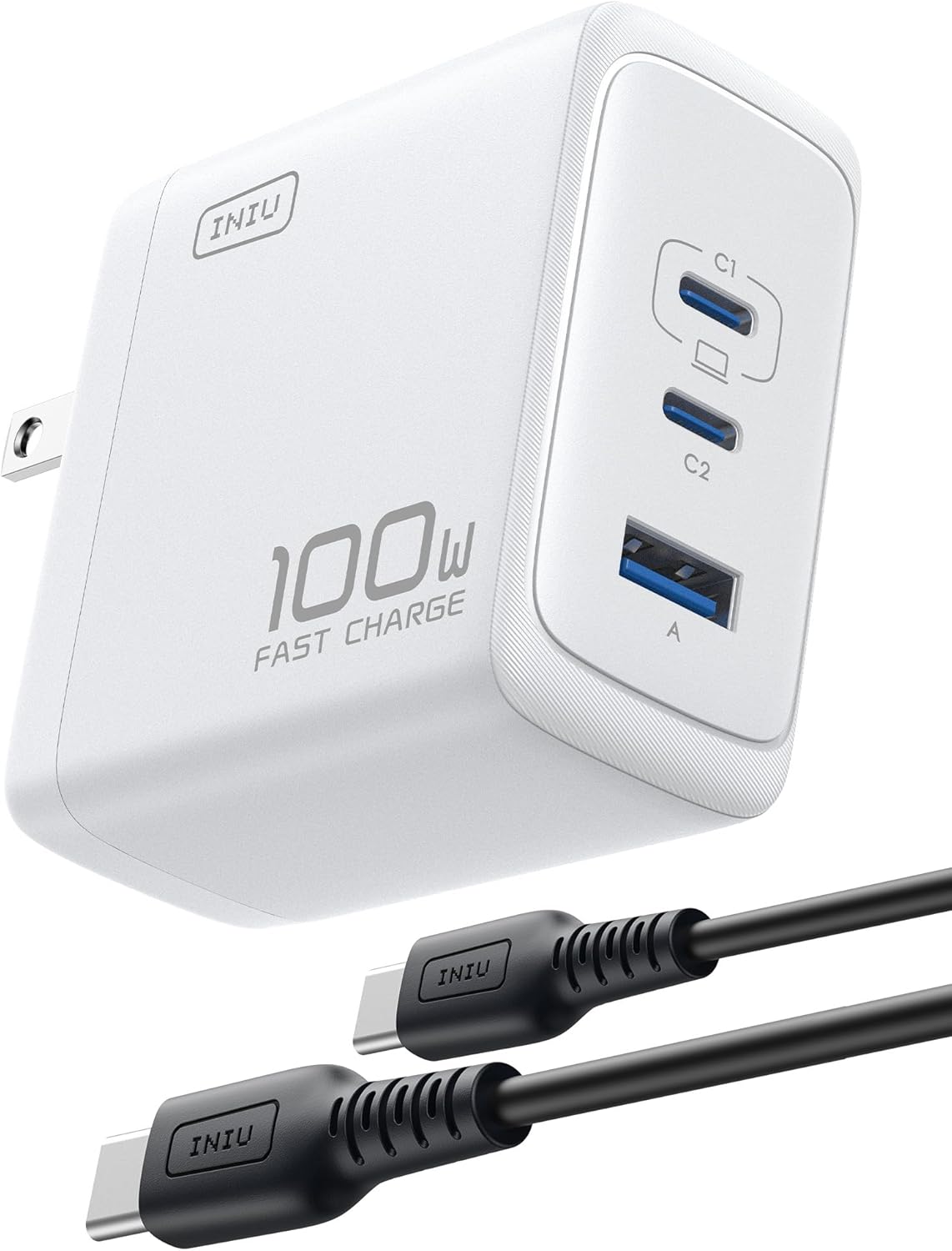 | 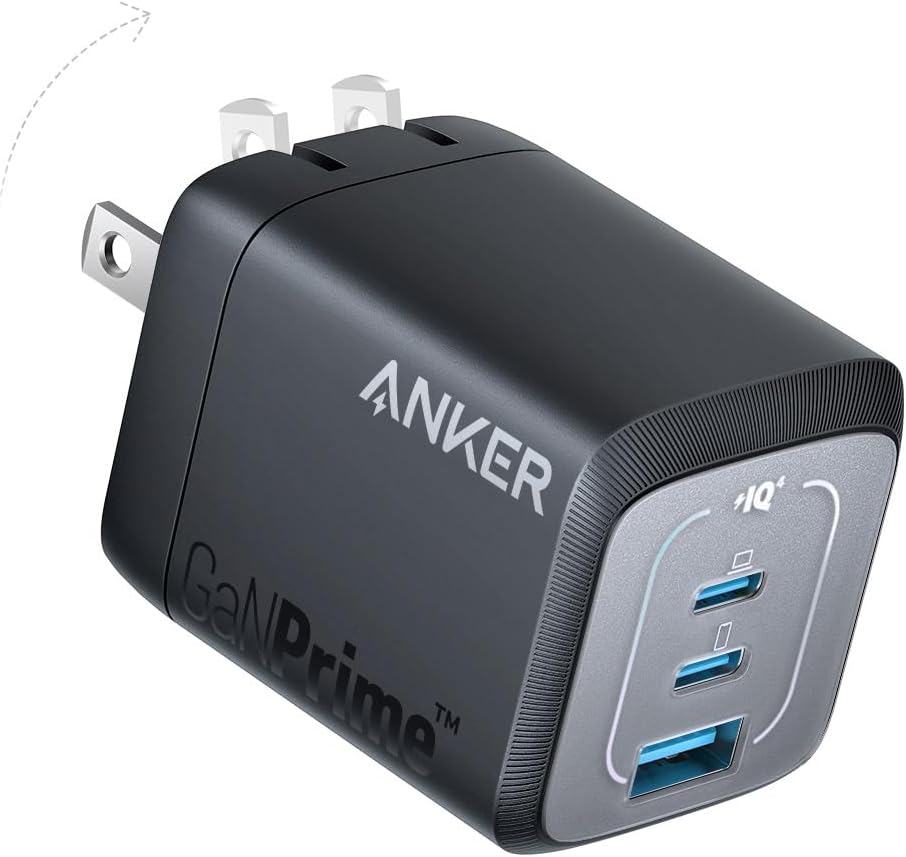 |
| INIU 100W 3-port GaN (B0DJ8C3MZD) | Anker Prime 67W 3-port (B0C4YTB56H) |
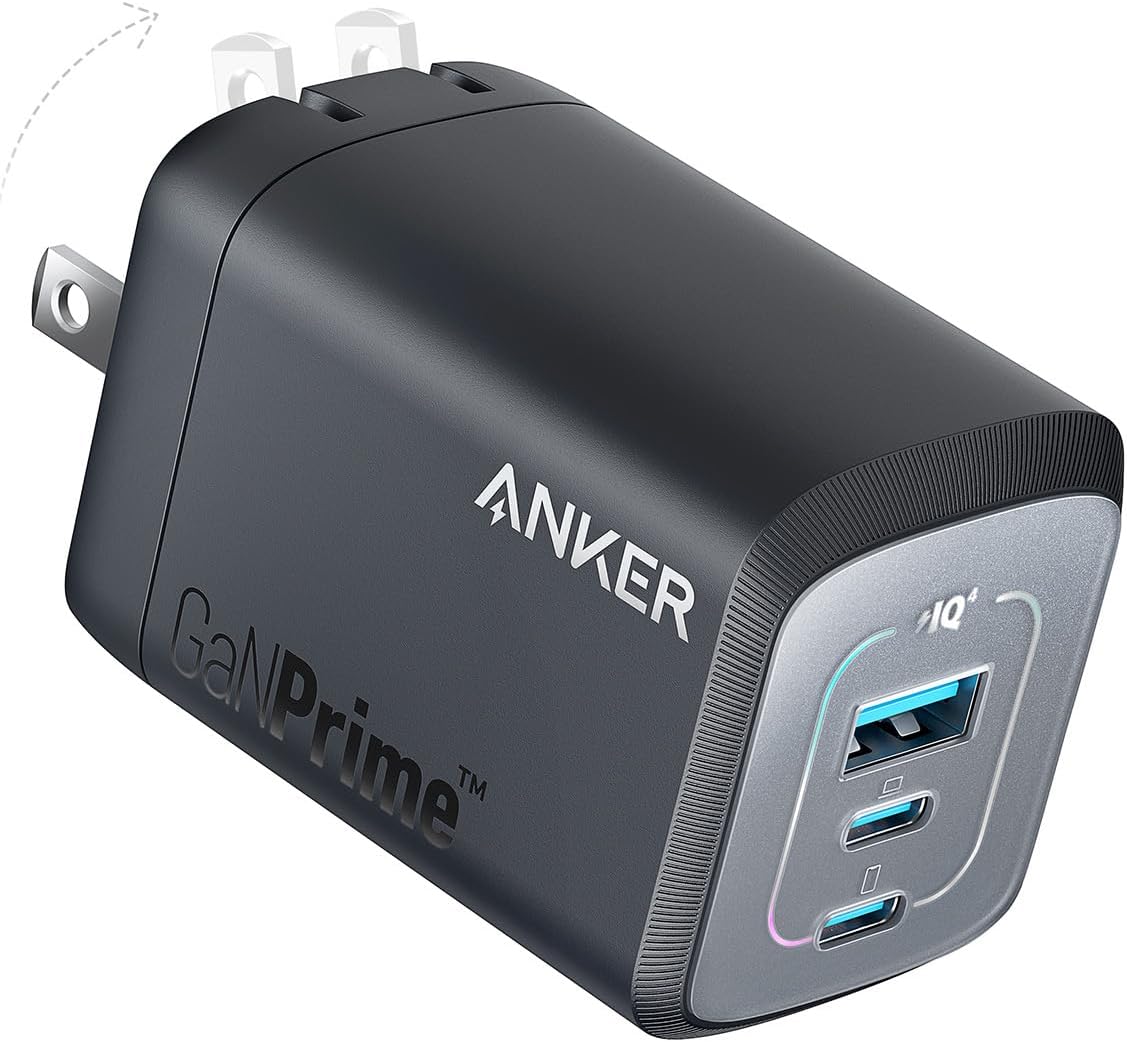 | 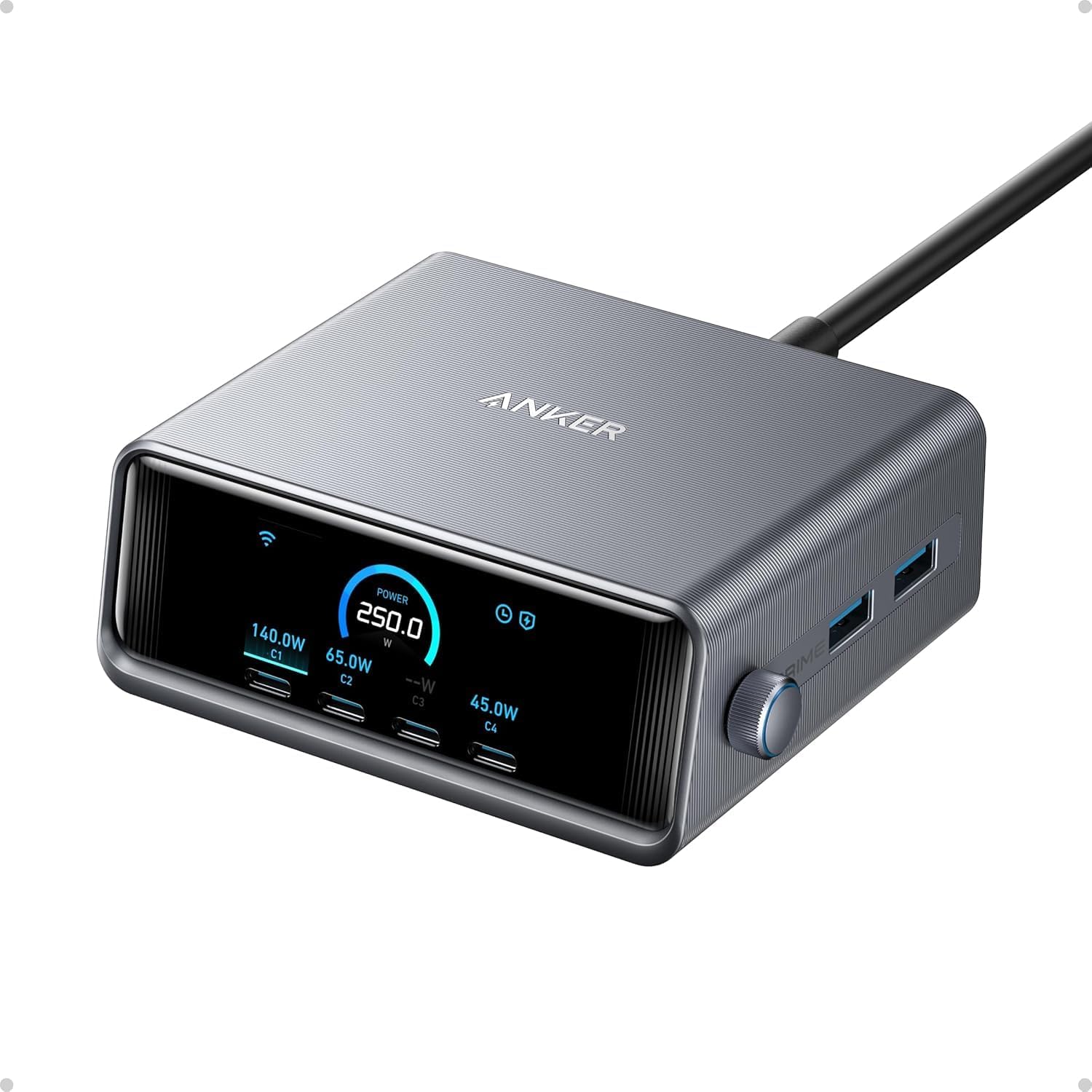 |
| Anker Prime 100W 3-port (B0C4DGBHY2) | Anker Prime 250W 6-port station (B0CYLL8Y89) |
All four advertise PD 3.0 + PPS. The first three are single-unit GaN; the last is a desktop power station, which on its higher-power port also supports PD 3.1 EPR (28V) for laptops. None implements VOOC, SuperVOOC, or any other proprietary protocol — generic chargers cannot, lacking both the MCU and the proprietary firmware.
When a OnePlus plugs into any of them, the negotiation proceeds as follows:
- Source capabilities. The charger advertises its PDO list, including PPS ranges such as
3.3–11V @ 5Aand3.3–21V @ 3.25A. - Phone selects PPS. The OnePlus selects the PPS PDO whose voltage range covers
~2 × battery voltage. - Phone requests V/I. It requests, e.g.,
8.94V @ 3.00A. - Charger complies; the phone's charge pump halves the 9V to ~4.5V at ~6A into the cell.
- Loop. The phone re-issues an adjusted V/I request every few hundred milliseconds.
The constraint is at step 3. OnePlus phones cap their PPS current request at ~3A, regardless of what the charger offers. A 100W single-port unit with a 3.3–11V @ 5A PPS PDO still receives a 3A request from the phone. OPPO/OnePlus reserves the high-current path for the proprietary protocol.
Measured draw at the USB-C connector with a power meter on a OnePlus 12-class phone:
| Battery state | Phone's PPS request | Wattage at the port |
|---|---|---|
| 0–10% (warm-up) | ~5V × 2–3A | 10–15W |
| 10–60% (bulk CC) | ~8.9–9.0V × 3.0A | ~27W |
| 60–80% (transition) | ~9V × 2–2.5A | 18–22W |
| 80–95% (CV taper) | ~8.7V × 1–1.5A | 8–13W |
| 95–100% (trickle) | ~5V × 0.5A | 2–3W |
Bulk-stage draw at the connector reads approximately 27W, sustained for 15–25 minutes before the taper.
The voltage choice is not arbitrary. The 2:1 charge pump in front of the single cell wants its input at approximately twice the cell voltage. A cell at 4.0–4.4V during bulk → request 8.0–8.9V at the port. The 3A figure is the phone-side cap.
Removing PPS — connecting the same phone to a fixed-PDO PD charger with no PPS PDOs — falls back to 9V/2A = 18W on a fixed rail. This is slower and warmer because the conversion stage no longer has voltage tracking and the charge pump cannot remain at its efficiency sweet spot across the curve.
Among the four chargers shown:
- The INIU 100W, Anker 67W, and Anker 100W deliver the same ~27W bulk to the phone. The additional wattage on the 100W units serves laptops and other devices.
- The Anker Prime 250W station also delivers ~27W to the phone. Its advantage is sustaining that rate while simultaneously running a 100W laptop on another port without throttling either.
- None triggers the SuperVOOC handshake. The "VOOC" indicator in OxygenOS labels any charge above an internal wattage threshold; it does not confirm the protocol.
PD-PPS versus SuperVOOC, head to head
Same OnePlus 12-class phone, same 5400 mAh dual-cell pack, two different protocols on the wire.
| Stage | PD-PPS (Anker / INIU) | SuperVOOC 80W brick | SuperVOOC 100W brick | SuperVOOC 150W brick |
|---|---|---|---|---|
| Negotiation | USB-PD messages on CC | Proprietary handshake on CC | same | same |
| Bulk voltage | ~9V | ~10V | ~10V | ~20V |
| Bulk current | 3A (phone-capped) | 8A | 10A | 7.5A |
| Bulk wattage | ~27W | ~80W | ~100W | ~150W |
| Cable requirement | any USB-C | OPPO/OnePlus cable with ID resistor | same | same |
| Battery topology assumed | dual-cell | dual-cell | dual-cell | dual-cell |
| 0→100% time (5400 mAh) | 75–90 min | 30–35 min | ~26 min | ~20 min |
| Heat felt at | the phone | the brick | the brick | the brick |
The 0→100% numbers do not scale linearly with peak wattage because the taper begins earlier at higher-power protocols. Cells absorb the peak rate only below ~70% state-of-charge; above that the curves converge as the battery itself becomes the bottleneck.
PD-PPS delivers approximately 27% of the phone's charging capacity. The remaining 73% sits behind a handshake that no third-party charger implements.
Summary
SuperVOOC speeds require three components, all of them:
- The OPPO / OnePlus charger with the SuperVOOC MCU at the matching wattage.
- The OPPO / OnePlus cable with the ID resistor.
- A SuperVOOC-capable phone — a flagship OnePlus from 2020 onward with the dual-cell pack and charge pump.
Missing any one falls the system back to USB-PD with PPS. The phone still charges, at approximately one-quarter of its peak rate, with the thermal load shifted from the charger into the phone, and a 0→100% time of roughly 90 minutes rather than 30.
The "VOOC" indicator in OxygenOS reports a wattage threshold, not a protocol. Generic 27W PD-PPS clears that threshold; so does 100W SuperVOOC. For ground-truth on the wire, a USB-C power meter — the ChargerLAB Power-Z KM003C is the common enthusiast tool — reads the advertised PDO list and live V/A draw directly.
Comments